Approach
Alternative Cinema Workshop (ACW)
A working history of questions, experiments and practices developed across more than two decades.
1. The Blind Spot
Before an Artist Can Be Educated, an Artist Must Be Born
After his debut feature film was banned, a young filmmaker felt the system had deprived him of his primary tool, which was his gaze.
For a filmmaker, the banning of a first film is not merely the erasure of a work. It is akin to having one’s tongue severed at the very moment they have begun to speak with the world.
Naturally, the question that arose for him was not, “What does blindness mean?” Rather, he asked: If a filmmaker’s eyes are taken away, can they still make films?
To answer this question, in 2004, Mohammad Shirvani organized a filmmaking workshop for blind women in Tehran.
The goal was not to prove that cinema is possible without imagery. The goal was not to construct a new pedagogical method. There was only a single inquiry: Can one make a film without seeing?
Nearly two hundred blind women volunteered. Fifteen entered the path.
In the beginning, the exercises were simple: Writing. Conversation. Self-portraits. Recalling personal memories.
Gradually, however, some participants became fascinated by the camera itself. Seven continued the journey.
For four years, a process unfolded that resembled an experiment far more than a pre-designed project. A single camera was passed from one person to another. They found their own stories, selected their own locations, and discovered their unique relationships with sound, memory, and space.
Along this path, something akin to a new découpage emerged, creating a language where the physical distance between the blind videographer’s body and the world became an intrinsic part of the cinematic syntax.
Before shooting, locations and lighting were discussed. Families were met. Ideas shifted repeatedly. Images slowly arrived, and the films mutated alongside this journey.
At first, no one knew if this was possible. It was only through the act of making that the possibility revealed itself.
Seven Blind Women Filmmakers / 2008
The culmination of these four years was an episodic feature film shot by seven blind women. Yet, the seventh episode was absent.
The seventh participant had crafted a self-portrait film documenting her romantic relationship with another woman. During the film’s festival screenings, instead of the final episode, only a single sentence appeared on a black screen:
“The final episode was censored due to its depiction of love between two blind women.”
But something unexpected happened. Each audience member constructed the missing episode through the lens of their own memories, experiences, fears, and desires. Censorship intended to eliminate the possibility of seeing, but instead, it multiplied the act of sight. The image was erased from the screen, but it lived on vividly within the spectators’ imaginations.
One day, during the years of that workshop, one of the participants removed her prosthetic eye. She placed it in the palm of the person next to her. The eye was passed around the oval table. Everyone touched it until it finally returned to its owner.
Nothing was explained. No one spoke of the philosophy of sight. Only an experience remained.
Working with blind women did not prove that cinema has no need for images. Something far more complex was revealed: Perhaps the image is not where cinema begins.
A few years later, another experience opened a new door.
The Tight Skin of the Ambience / 2011
Working with deaf men brought forth another question: If a shared language does not exist, can we still reach the Other?
The speed and complexity of sign language were to be expected. The true wonder, however, was the connection that formed between them and us. There were almost no shared words, yet understanding often occurred faster than in a conventional conversation. The bodies were in a constant state of articulation. Communication did not merely pass through words; it was shaped by movement, rhythm, and bodily presence.
At this juncture, ACW was no longer just about making films. It was about discovering the hidden sources of cinema, specifically the elements typically ignored in formal education: The Gaze. The Body. Silence. Distance. Presence.
Working with blind women showed that perhaps the image is not where cinema begins. Working with deaf men showed that perhaps a shared language is not the only way to reach the Other.
And these two experiences added a fresh question to ACW: If cinema begins neither with the image nor the word, where does it begin?
2. The Playground
Before Learning Cinema, Creating a Place to Exist
People do not learn their mother tongue through theory. A child does not begin with grammar. They do not study linguistic structures before speaking.
First comes listening. Playing. Making mistakes. Imitating. Expressing a desire. Finding a personal relationship with the world. Grammar comes later, not at the beginning.
This simple observation gradually transformed into a critique against conventional art education. Many film schools begin with language: History. Theory. Rules. Analysis. And production is often placed at the very end, as if the filmmaker must first be intellectually certified before being permitted to create.
ACW started from the exact opposite premise. Production was not the result of learning; production was the learning itself.
This approach did not arise from a theoretical stance. It arose from experience.
A new question took shape: Is it possible to create conditions where people can find the capacity to see again, before becoming filmmakers?
In 2012, a small apartment in Tehran’s Ekbatan Township became the first playground for the Alternative Cinema Workshop.
The initial participants were mostly film school graduates. They were intelligent, passionate, and deeply eager to converse about cinema. However, a problem became evident: many of them were prepared to talk about filmmaking for hours before ever experiencing it.
The workshop gradually enforced a different rule: the camera had to enter immediately. The body had to enter the process. The idea had to become action.
In its first year, the workshop moved to an old villa with a small garden in Tehran’s Amirabad neighborhood. For the next thirteen years, that house was far more than a classroom. It was a sanctuary, a laboratory, and a temporary community of artists exhausted by the status quo. Some traveled hundreds of kilometers every weekend just to be present. Out of hundreds of applications, only about thirty entered each cycle.
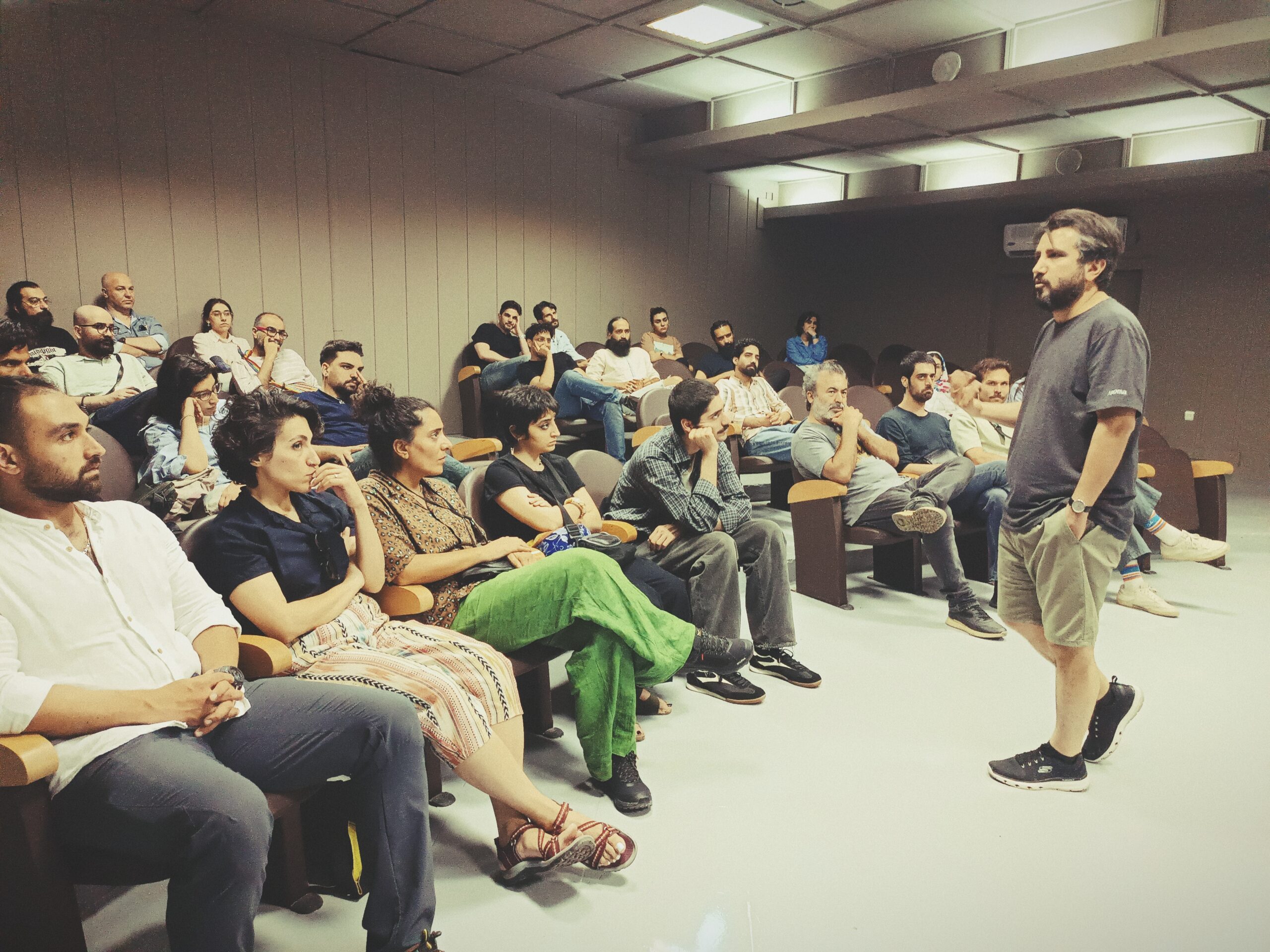
Once inside, however, the traditional hierarchy between instructor and student dissolved. The space belonged to the participants. The classroom was cluttered with: Cameras. Experiments. Failures. Improvisations. Film screenings.
Discussions were almost always centered on works created just hours prior. Learning did not happen after production; learning happened within production.
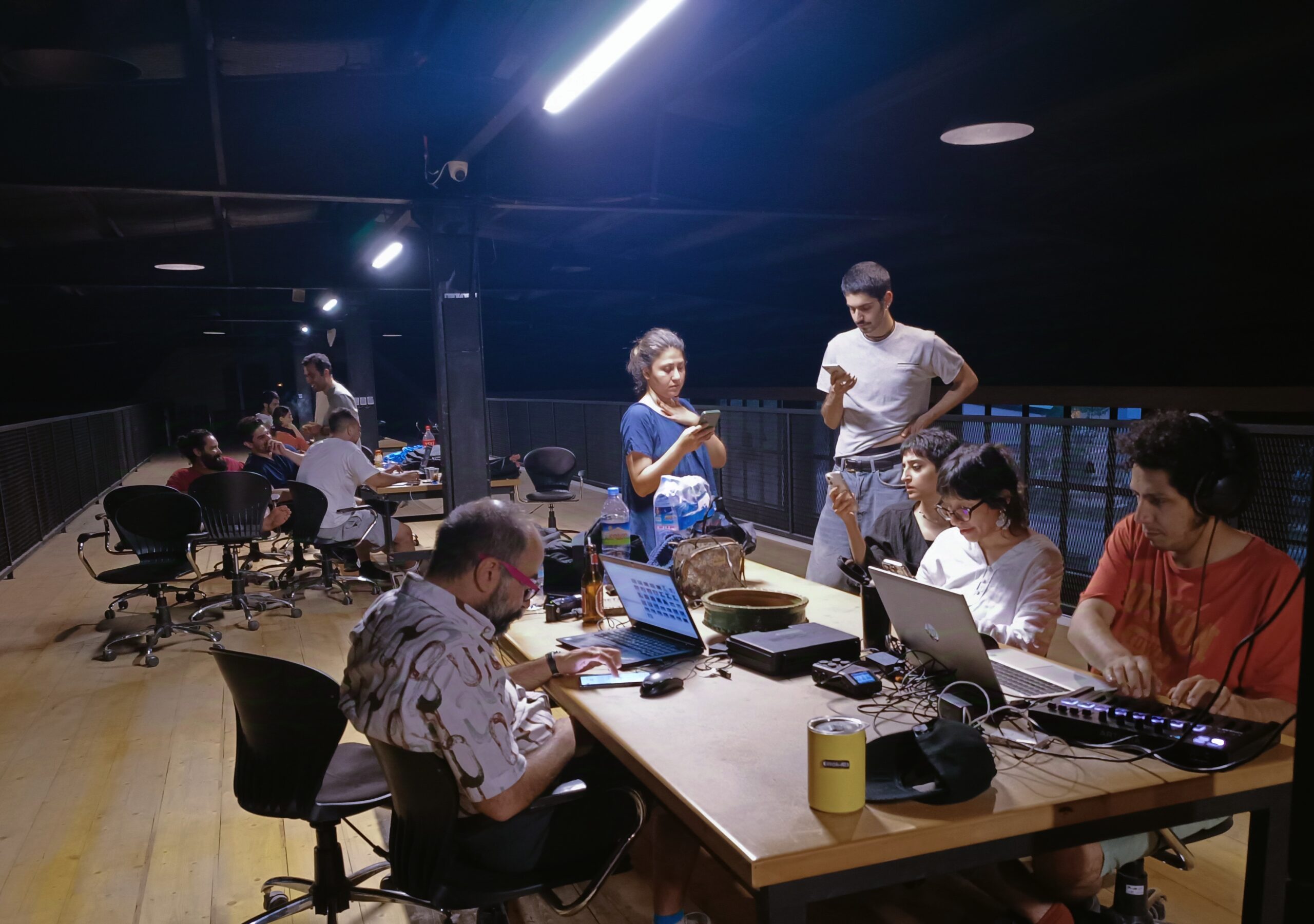
The workshops were officially scheduled to last a few hours, but in reality, they rarely respected time. Fridays, which are typically a day of rest in Iran, became our most intense workday. People arrived in the morning and sometimes stayed until two o’clock past midnight. No one wanted to leave. There was always one more experiment, one more scene, one more idea to test.
Yet, this intensity also exposed a critical vulnerability. Within the workshop, many participants discovered they could make films. But outside, the weight of daily life returned through economic pressure, isolation, and the lack of collective energy. Many confessed that while they could produce within the workshop, they fell silent the moment they returned to their daily routines.
This fracture raised a new question: What would happen if the process of relentless practice flowed directly into daily life? What if the groups formed in the workshop actually lived together while constantly practicing?
From this very question, the annual camps were born.
For ten days, filmmakers from diverse regions and cultures of Iran gathered in mountains, villages, forests, and deserts. These camps were not a vacation from education; they were education at its most condensed. Here, it was no longer just exercises placed side by side.
Bodies. Gazes. Experiences. And time. Everything converged, and a shared cinematic body formed rapidly.
Mornings: Deconstructing the exercise. Until Dusk: Producing and executing ideas. Dusk to Late Night: Editing. Late Night: Screening the works on the wall.
This non-stop rhythm gradually welded fifty individual filmmakers into a single, collective cinematic body.
One of the most unforgettable collective cinematic bodies took shape during the 2014 Maranjab Desert Camp. People usually visit the desert to experience silence and meditation. However, a group of urban filmmakers entered the desert and immediately transformed its void into a car race, acting as if they had to discover the joy of friction and risking danger on the dunes before ever discovering the desert’s tranquility.
Later, the desert slowly transformed them through its minimalist landscapes, an endless horizon, a vast sky thick with stars, silence, a relationship with sound, and the stripping away of everything non-essential.
A ruined fortress became the center of a collective experiment involving twenty-five filmmakers and twenty-five five-minute films. But these twenty-five films were not isolated entities. They all occurred within a shared space and a shared time. A feature-length film was captured in real-time, without a single cut. A camera was handed off from one filmmaker to the next. A performer in one narrative would suddenly receive the camera and become the filmmaker of the next story. Individual narratives mutated into a collective organism.
At the time, there was no name for this method. Years later, this experience became one of the foundations of Live Cinema. But what happened in the desert, prior to any label, was a simple discovery: Twenty-five solitary experiences inside one collective body.
3. The Body Before the Image
Freedom as Practice
Before an artist learns how to direct another body in front of the camera, perhaps they must first discover their own.
Throughout the trajectory of ACW, one observation returned repeatedly: many participants did not suffer from a lack of imagination, but rather from accumulated fears. Fear of failure. Fear of judgment. Fear of appearing ridiculous. Fear of crossing invisible boundaries that had been repeated so often they became hardwired into the body itself.
In a society where many limitations were not just external but had gradually solidified into habits of self-censorship, the primary question was not how to create an image. The primary question was: Can a body become liberated enough to enter the world differently?
For this reason, some of the most critical experiments at ACW had almost no direct connection to cinema, at least not traditionally. Instead, they focused on the relationship between the body, fear, and the gaze of others.
One of these moments occurred during a camp in northern Iran around 2014. The group arrived at the campsite by bus. Prior to their arrival, a sixty-meter portable bungee jumping crane had been rented. This event was designed to open the camp. Almost no one in the group had experienced jumping from such a height. Everyone was terrified, including the person who had set up the scenario.
But someone had to jump first. The first jump was executed with an outward calm, masking the terror beneath. Then another person jumped, and then another. A temporary rule was jokingly manufactured: “If you don’t jump, you can’t be a filmmaker.” It wasn’t true, of course, but for a few moments, everyone believed it.
Nearly the entire group jumped. All the women jumped. Only two of the men did not.
When everyone returned to the ground, something had shifted. This experience was not merely about overcoming a fear of heights. An entirely different energy had entered the group. The body had discovered it could perform an action it had previously deemed impossible. This energy sustained itself throughout the rest of the camp, infusing the filmmaking process. Before the camera even arrived, the body had opened a new domain of possibility.
Later that day, on the way to lunch, another idea materialized. The group decided to transform dining into a performance. There was very little time to prepare, only twenty minutes.
The decision was made: they would enter a formal, luxury restaurant. They went not as filmmakers and not as themselves, but as a group of intellectually disabled individuals accompanied by two instructors from a fictional charity institution. The restaurant was unaware, and the patrons were unaware. The participants had only a few minutes to discard their conventional social identities and inhabit another persona.
But something unexpected occurred. The group anticipated resistance and expected social friction. Instead, the opposite happened. People granted an uncanny freedom to those perceived to exist outside conventional societal rules. The staff became complicit in the event, while patrons reacted with curiosity and acceptance. The atmosphere shifted. The participants acted without the armor of their usual self-image. Every expectation of how a human being should behave in a formal public space collapsed. And instead of rejection, another possibility emerged in the form of a permission, revealing a kind of freedom that is usually hidden behind social roles.
Following these two experiences, the group’s energy transformed. It was not merely self-confidence; it was a completely altered relationship with the world.
A lingering question remained: How much of everyday human behavior truly belongs to the individual, and how much of it is merely a performance staged for the gaze of others?
Subsequent urban performances continued this line of inquiry. Participants entered public spaces and provoked confrontations through behaviors that disrupted normal expectations. Sometimes the public reacted, and sometimes the police intervened. Occasionally, they were detained for a night and released the next day. But the objective was never protest; the objective was observation. What happens when a body moves outside the script written for it? Time and again, the same discovery returned: The first censorship is not always external; the first censorship lives inside the body.
ACW did not attempt to teach people how to construct images. Before the image, something more foundational had to occur: a body that had acquired the capacity to enter the world without fear. For cinema does not begin the moment the camera records; cinema begins the moment a human being becomes entirely present.
And perhaps before an artist can be educated, they must first discover the freedom to exist.
4. The Other as a Mirror
When Identity Disappears
Years before blindness became a long-term path within ACW, another experiment had begun with a similar question: If the gaze of others is removed from a human being, what remains of them?
In 2011, a performance titled OPEN was staged in a formal gallery in the heart of Tehran, under the framework of the program Thirty Nights, Thirty Artists, Thirty Performances.
This event took place during a time when even a private mixed-gender house party with music and dancing could be highly problematic. Yet, OPEN outwardly possessed all the markers of a party: Music. A DJ. Dancing. Food. Men and women sharing the same space. It looked like a party.
However, one simple rule altered everything: No one could enter using their own identity.
At the entrance, each participant received a blindfold. Their name, occupation, and social status were discarded. A number was pinned to their chest, and they were asked to completely forget their social ID and persona for the duration of the event. Inside, they were no longer an individual; they were a digit.
One of the blind participants from the previous workshops stood at the entrance, handing out the blindfolds. Another person stamped the word OPEN onto their wrists. They were to leave their external identities outside the door.
Among the participants was a major female superstar of Iranian cinema. Her presence was part of the performance’s covert design, occurring unannounced, unintroduced, and entirely unknown to the others in the room. She, too, put on the blindfold, discarded her name, and for a time was simply “Number 5.” One of the most recognizable faces in Iranian cinema became one of the most invisible people in the room.
For nearly two hours, no one confronted her fame, her past, or her public image. There was only voice, movement, and presence.
Something extraordinary occurred. Connections formed with incredible speed, and people opened up rapidly. Bodies entered a different dimension, dancing commenced, and voices shifted. Laughter, shouts, and movement replaced people’s prior images. Those who could not see one another found each other through alternative means, specifically sound, motion, and presence.
One of the most profound outcomes of OPEN was not the elimination of imagery; it was the forgetting of the gaze of others, marking the exact moment the body ceases to perform for visibility.
Even simple things changed. Because alcohol was prohibited, the party was stocked with cans of energy drinks. Finger foods, which are normally selected by sight, became uncertain objects without vision. People touched them, examined them, and hesitated with a mix of relish or suspicion before making a choice.
A video room had been constructed inside the gallery. Participants entered one by one and spoke to a handheld camera about their experience. Many spoke of the number they had become. A few days later, some of them took to Facebook, announcing their numbers and searching for the digits they had connected with in the dark. They were not looking for a face; they were looking for the person they had felt close to without ever seeing.
Some visitors, even after exiting the gallery, returned to the queue just to re-enter as a different number.
For a few hours, it was possible to experience an alternative identity. Outside the gallery, the artist stood before the waiting line dressed in a collection of bizarre, mismatched clothes borrowed from others. To those waiting to enter, he became an unconventional spectacle that served as the object of gazes and judgments. Yet here, too, the boundary between performer and spectator dissolved. No one stood outside the experience; everyone was an active component of it.
The success of OPEN also revealed its limitations. After a short time, the gallery received a warning from the censorship authorities. The reason was simple: men and women were dancing and touching one another. The performance had to be halted or altered. Ultimately, the experience was segregated into separate sessions for men and women, but something had fundamentally broken. The unpredictable energy of the shared experience vanished, and the bodies retreated to familiar boundaries.
Nonetheless, by the end of the festival, many regarded OPEN as one of the most enduring experiences of the collection because it had experimented with something far beyond a party. It posed a question: How much of the human being standing before us is truly themselves, and how much is an image we have already constructed of them?
Perhaps identity is not merely something we carry within; sometimes it is something we perform exclusively for the gaze of others.
5. Live Cinema
Skin in the Play
One of the most striking discoveries of our cinematic journey was that some of the most powerful moments emerged precisely when cinema was no longer entirely under control.
Traditional film education often teaches the filmmaker to subjugate reality. The location must be controlled, the actor must follow the script, the lighting must be engineered, accident must be eliminated, and the unexpected must be eradicated.
Yet, through years of experimentation, another possibility slowly manifested: What if the unexpected is not a problem? What if it is a collaborator?
This concept did not originate from theory. Instead, it emerged from practice through years of working with diverse cinematic forms and, later, through the laboratory path of ACW. The workshops were intense, and there was little patience for endless debates. Participants wanted to hold the camera, move their bodies, make mistakes, and immediately witness the consequences of their choices.
One of the most vital sets of experiments at ACW was built upon what would later be termed Live Framing, Live Mise-en-scène, and Live Découpage.
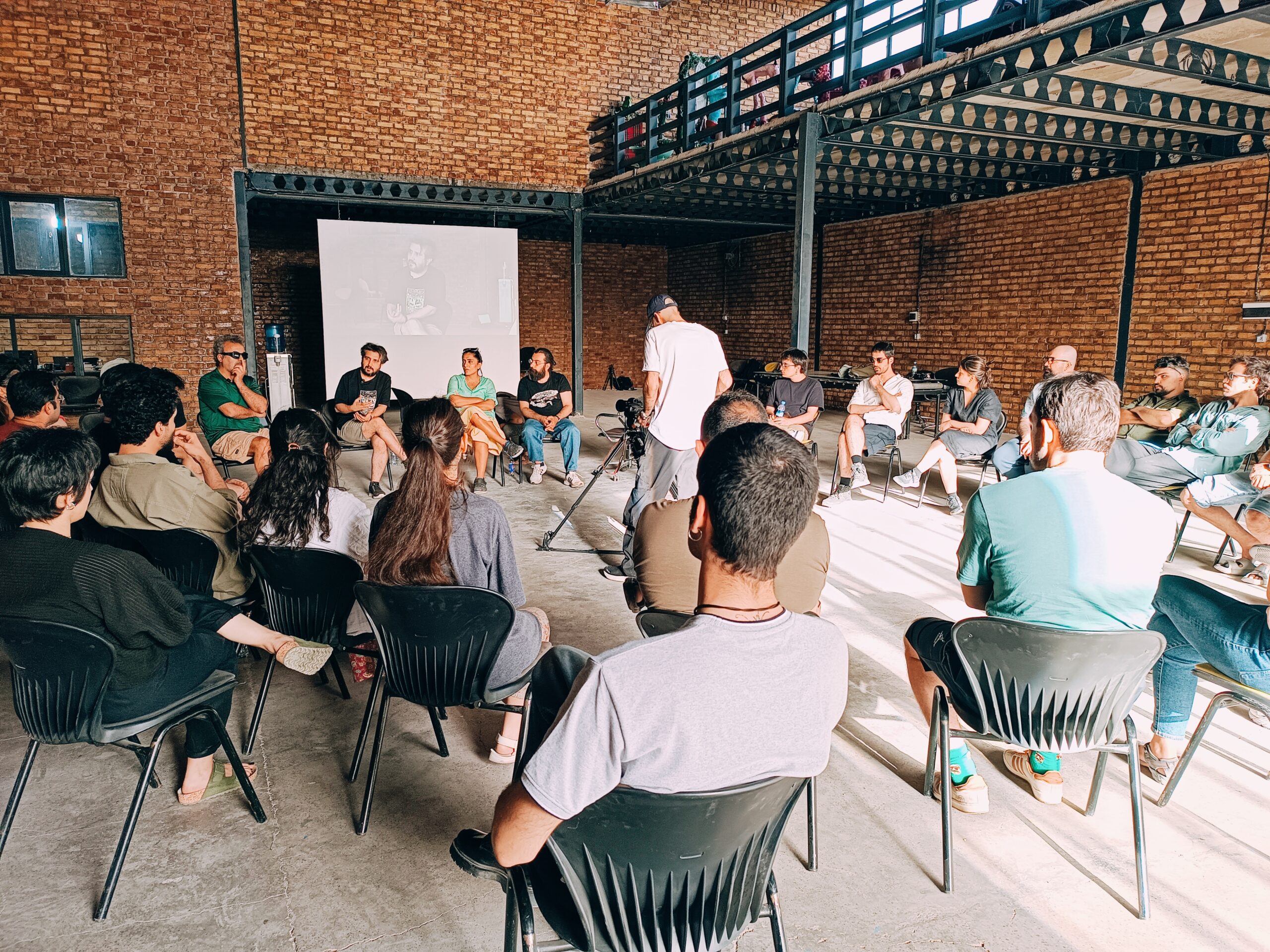
These exercises were executed in front of a camera hooked directly to a large projection screen. The camera did not merely record; it revealed. Anyone could step behind the lens and immediately see the results of their decisions projected live.
A microscopic shift in distance, an alternative bodily movement, or a fresh relationship between the camera and the performer made everything visible in the exact moment of its occurrence. A close-up transformed the emotional weight of a face. A different camera placement altered the dynamic between two bodies. A simple movement constructed an entirely different scene.
The image was not something to be explained later; the image was experienced in real-time. The body learned before the mind.
Over time, these experiments unveiled something essential: Cinema is not merely the organization of images; cinema is the organization of relationships.
This included the relationship between the body and the camera, between the performer and the filmmaker, and between intention and discovery. Control and freedom began to coexist.
Years later, when looking back at the films I had made, I noticed invisible threads connecting some of them. A methodology was slowly revealing itself, not as a theory and not as a pre-designed system, but as the consequence of a long laboratory trajectory. This was the very path that was later named Live Cinema within ACW.
This is a cinema that does not begin with a finished image, but rather a cinema that begins with a live situation.
I once read the phrase, “Skin in the play.” It did not mean that practice does not exist in art; practice is indispensable. However, it is not practice aimed at reproducing something already designed and finalized on paper.
In Live Cinema, instead of preparing bodies to execute a final script, we first place the body and the space into an actual relationship. Skin enters the situation, the experience occurs, and the performance begins at a point where everything is not yet absolute.
In Live Cinema, a treatment exists, a structure exists, and key turning points exist. But the script is not a closed system; it continues to grow within the scene.
The words written on paper are merely an initial framework. When the bodies, the space, and the camera enter, the script is rewritten. It is not one medium literally translated into another; rather, an entirely fresh medium is born. The final notes remain valid until the night before shooting, but they do not step onto the set with the director.
For this reason, fixed découpage and industrial storyboards hold no meaning in Live Cinema.
The first take acquires supreme importance in Live Cinema. Sometimes the first execution is the most alive, marking the moment when the filmmaker and the performer discover something far beyond their own original intentions. The first audience of the scene are the filmmaker and the performer themselves.
The metric of success is a moment of wonder: “Wow… I never thought we would end up here.”
In Live Cinema, the filmmaker and cinematographer function as a single, unified body. The camera becomes an extension of that body. There is no distance between the person behind the lens and the image being born. The camera does not witness the scene from the outside; it is inside it, it intervenes, and it becomes one of the performers, specifically a humble, hidden performer.
The filmmaker simultaneously becomes the Director, the Cinematographer, the Editor, and the First Spectator, all within one body.
The camera must assume that the frame finishes right here and that there is no future editor who will rescue the image later. Consequently, in long takes, the rhythm and tempo of the film are birthed by the movement of the camera itself.
This does not imply the elimination of editing. On the contrary, in Live Cinema, the final script is rewritten first with the camera, and then with editing. Therefore, the editing process will often be significantly longer than the shoot.
This realization later became one of the pillars of what ACW termed Live Cinema. It is not a style, not a genre, and not a technique, but rather a relationship.
This is the relationship between intention and reality, between structure and uncertainty, and between the filmmaker and the world.
Perhaps the most radical discovery was this: Sometimes the most powerful image emerges precisely when the world is permitted to answer back.
6. The Elephant in the Darkness
The End of a Single Meaning
At the 2013 Rotterdam Film Festival, people stood in lines to witness something that could not be seen. A massive wooden crate sat in the middle of the hall, resembling an industrial shipping container. It was covered in labels, looking as though it had emerged from a long journey sent from Iran to Europe.
Yet, no one was permitted to open it. One could only insert a hand through holes in the crate to touch its contents, or press an eye against a slit to peer inside the massive cube.
Some touched something soft, others something cold, some felt skin, and others felt hair. Some were certain they had encountered a real body, while others believed an animal was inside the box. Some were terrified, some laughed, and others felt a wave of shame. No two people encountered the exact same thing, yet everyone was entirely certain they had grasped the truth.
Inside the box sat nothing but a faceless female mannequin. Yet the artwork was never about the mannequin; the artwork was about the spectator. They had entered the exact condition described centuries ago by Rumi in the tale of the Elephant in the Dark, which is constructing an absolute truth out of a fragmented experience.
This was not merely a standalone piece; it became one of the latent questions of ACW: How can we see something before we know its name?
After Rotterdam, this question lingered within ACW for a long time: Do we truly see the world? Or do we only see what we have already decided about it?
Perhaps this is one of humanity’s oldest habits. We think: This is a chair. This is a house. This is a mother. This is a failure. This is a love. This is an enemy.
Yet perhaps none of these are the ultimate truth; perhaps they are merely names we have stamped upon things.
From this starting point, exercises in defamiliarization were born. They were designed not to render the world bizarre, but to see it anew. A chair was no longer just an instrument for sitting. A bed was not merely a place to sleep. A television was not solely for viewing. A door could be a wall, a wall could be a passageway, and a room could be a prison or a sanctuary. Everything depended on the relationship constructed with it.
Later, the defamiliarization of objects evolved into the defamiliarization of situations: A fight. A meeting. A job interview. A classroom session. A family dinner. A funeral. A romantic date.
All these situations seem pre-written. Everyone knows exactly how they are expected to behave. But what happens if someone steps out of the game? What if someone refuses to execute the script? Suddenly, entirely new things are witnessed, not only within the situation, but within the person themselves.
In another ACW exercise, participants were asked to write a list of things they had always wanted to do but never possessed the courage to execute.
The lists were strange, humorous, tragic, and terrifying.
Some wanted to resign from their jobs, some wanted to tell their fathers something they had hidden for years, some wanted to confess their love, some wanted to say no, some wanted to travel alone for the first time, and some merely wanted to run down the street.
When these lists were read aloud, the workshop transformed. It was as if the hidden lives of these individuals were being witnessed for the very first time.
Subsequently, some of these desires were converted into performances. They did this not to become brave, as bravery was never the objective. The objective was sight, specifically seeing how fear organizes our world, and seeing how the world can take on an entirely different shape with a microscopic movement.
Yet this sight was not merely self-directed. Each performance thrust the individual into a fresh relationship with the Other, including their family, the city, and a society they had previously only thought about from the outside.
Along this path, something else revealed itself, which was the aesthetics of flaw.
We did not attempt to camouflage weaknesses; instead, we transformed them into creative raw material. A stutter could become the language of a film, fear could be converted into drama, embarrassment could become a performance, and trauma could mutate into a narrative.
At ACW, a flaw was not something to be corrected. Sometimes it was the exact point from which the work began.
But perhaps the most significant defamiliarization was the defamiliarization of the “Other,” including family, the city, convention, and values that have been repeated so frequently they appear natural. Every society possesses a collection of pre-written roles: The good child. The successful man. The appropriate woman. The true artist. The acceptable citizen.
But what if these roles are merely conventions? What if one could step outside them for a single moment?
Perhaps creativity begins precisely there, at the exact point where the world ceases to seem self-evident. We do this not to find the truth, but to prevent ourselves from manufacturing it prematurely.
Perhaps the artist is not someone who adds a new meaning to the world. Perhaps the artist is someone who permits the world to become unknown once again.
And perhaps creativity is nothing other than the capacity to touch the elephant in the darkness without immediately rushing to find a name for it.
7. The 360° Perspective
The End of a Single Center
The discovery of the 360-degree perspective did not begin with a camera technique. It began with a question: Does cinema always require a center? This means a main character, a primary drama, a dominant gaze, or a single vantage point from which the world becomes intelligible.
For over a century, cinema was constructed upon this very organization. The camera dictates what we see, the director dictates what is critical, and the narrative dictates who stands at the center and who remains on the periphery.
But life never operates this way. Every human being carries their own world within a space, including their own history, their own fears, their own desires, and their own interpretation of a shared event. A room does not host just a single occurrence; there exist as many distinct realities as there are people inside it.
The question became: What happens if cinema relinquishes the search for a center? What if it permits multiple centers to exist simultaneously?
During an ACW camp in the Maranjab Desert, this question was converted into a practical experiment. After settling into an abandoned fortress, twenty-five filmmakers entered a game. Each was to construct a five-minute narrative film, but not in isolation.
There was only one camera. Each filmmaker had five minutes to execute their film live, and then the camera was transferred to the next person without a single cut. But the next filmmaker was the exact person who had been a performer in the previous film. An actor became a filmmaker, and a filmmaker became an actor. One narrative was handed off to the next. The final person, who was the mentor himself, completed this unbroken 125-minute chain.
This experiment was never presented as a finalized film. It was a live prototype and an experiment to see if a film could take shape without individual ownership, without a single center, and without a single cut.
Yet its most profound discovery was neither the form, nor the long take, nor the camera hand-off. The most critical discovery was the formation of a collective body. Twenty-five filmmakers, for the very first time, were placed not side by side, but inside a single, unified movement.
Years later, another experiment continued this inquiry within a public space, specifically in front of the Tajrish metro station in Tehran: A girl was weeping. Another girl was collecting money from strangers to abort her fetus. A man and a woman were fighting loudly, then reconciling through the intervention of the public. A girl was embracing strangers by mistake. A girl was dancing with her body. A girl was interviewing passersby. Simultaneously, a live band played at the metro entrance. And a camera stood at the center of this square.
The question was simple: If everything occurs simultaneously, who has the right to be the center? The camera sat on a platform at the center of a circle with a radius of approximately one hundred meters. It could pan completely from a wide shot of the entire square and suddenly land on the face of a passerby. Simultaneously, seven channels of wireless audio flowed into the director’s ears, capturing the voices of all six performers and the music. Filming resembled directing a live current far more than recording a scene.
The director had to decide in every split second: Who do we see, and who do we only hear?
Sometimes we saw the image of the weeping girl while hearing the couple’s argument from somewhere outside the frame. Sometimes the frame showed an empty square, yet the voice of an absent character propelled the film forward. It was as if editing, sound design, and cinematography were occurring simultaneously within a single body.
Like the Maranjab Desert camp, this experience was not a final film. It was a live prototype, serving as an experiment designed to lay the groundwork for a future performative feature film.
Yet it unveiled something crucial: when the center is eliminated, the spectator can no longer remain passive. The people present on the street were not merely onlookers. By asking questions, intervening, and altering the trajectory of a situation, they stepped inside the construction of the work.
The spectator of the final film was likewise no longer the representative of a single gaze. There existed as many angles of vision as there were people present in that space. The 360-degree perspective was ultimately not about the rotation of the camera; it was about the rotation of the gaze. This served as an exercise in dismantling the dictatorship of a single situation, a single truth, a single hero, and a single center.
From its very inception, ACW advanced through the collapse of certainties: The image confronted by blindness. Language confronted by silence. Identity confronted by the Other. Control confronted by the Live. Meaning confronted by darkness.
And now: The center confronted by multiplicity.
Perhaps cinema begins at the exact moment when no one desires to be the sole viewpoint of the world. For cinema does not require a center to exist; it requires a relationship.
8. The Birth of the Artist
The Blind Spot: The collapse of the dictatorship of the image. Before the image, we rediscovered sight.
The Playground: The collapse of the dictatorship of education. Before learning, the possibility to live and play was constructed.
The Body Before the Image: The collapse of the dictatorship of the mind. The body entered before the concept.
The Other as a Mirror: The collapse of the dictatorship of identity. The Other became a mirror to see the self.
Live Cinema: The collapse of the dictatorship of control. The filmmaker permitted the world to answer back.
The Elephant in the Darkness: The collapse of the dictatorship of a single meaning. The world became unknown once again.
The 360° Perspective: The collapse of the dictatorship of the center. No one was the absolute center anymore.
ACW Perhaps all these years were not about cinema. They were about the artist, specifically about the moment something shifts inside a human being. This happens not by acquiring a technique, not by memorizing a theory, and not by finding an answer, but rather by losing certainties.
When the image is no longer sufficient, when ready-made answers collapse, when the body re-enters the world, when the Other ceases to be a stranger, when control fractures, when meaning remains incomplete, and when the center vanishes.
In that exact moment, something is slowly born. This is not an expert, not a technician, and not even a filmmaker, but something far more fragile: someone who can be astonished once again. Someone who can meet the world unknowingly. Someone who can confront something without immediately wishing to explain it.
Perhaps the artist is not the one who knows more; perhaps they are the one who has not lost the capacity to live with not knowing.
Fourteen years ago, this was merely a suspicion. Today, it is still not an answer. It is simply that old question, standing firmly in its place: Before an artist can be educated, how is an artist born?
Epilogue
Alternative Cinema Workshop: A Workshop, Not a School
There was never an attempt to construct a closed school. Every experience that took shape over these years emerged out of questions, not out of answers.
There is no final formula. There is no sacred method. There is no blueprint that can be replicated identically.
From the beginning, ACW resembled a laboratory far more than an educational institution, providing a space to experience, to make mistakes, to see anew, and to build a fresh relationship with the self, with the Other, and with the world.
Perhaps the most significant achievement of these years is neither the films nor the exercises, but the possibility of forming a temporary community of individuals who, for a brief moment, dared to see the world entirely anew.
Now, this path stands at a fresh vanguard. After years of activity in Iran, ACW is prepared to continue its experiment across other geographies and cultures, working in collaboration with artists, independent spaces, laboratories, and institutions that do not yet view education as a closed, hierarchical system.
This is done not to export a method, and not to repeat an experience.
But to continue that exact, ancient inquiry: If there are still so many things we do not know, if the world can still be seen differently, if unexplored possibilities still exist, then why not begin again from the very beginning?